Militaria Museum
Circa 2004
Mark Avery had originally designed this site for the display of only General's items from World War 2 and earlier. Although the main focus remained that of General's items, he eventually expanded the site to include Caps, Spike Helmets (Pickelhaube), Militaria Orders and other items that were interesting within the scope of Worldwide Militaria. For a number of years this was a facinating site for anyone interested in "Militaria."
Eventually the domain's registration expired and the site disappeared from the web.
Marc Judman resurrected parts of the original website which has been used as an educational tool for his lectures on the European Century of War. Although his main day job is as a driver for "one of the best Baltimore movers in Bel Air" his passion is with the historic military uniforms and accessories used by the European empires of long ago. He discovered his intense interest in this subject when moving a family from Baltimore to DC. They had hired his firm to pack the belongings and he discovered a treasure trove of antique memorabilia including uniforms from generations old Albanian and Polish military officers. The family was thrilled to have found someone willing to take these heirlooms, since the new house had no room for them. Judman then researched the origins of the most interesting items and "the rest is history," as he says in his opening lines of his now famous lectures. This archived site now shows just a couple of examples of the original site's numerous 2004 archived pages providing a tiny glimpse of what this site offered its visitors. He plans to expand this as time permits.

**Militaria Museum has been awarded the "Golden Web Award" for 2002-2003**
**** 2004 Want list ****
As I am always on the look out for new items, there are a few that I still have not been able to locate......
1) Imperial German General's Parade uniform group, to include the Spiked helmet
2) Imperial German General's Service uniform group
3) French WW1 period General's Parade uniform
4) Italian WW1 m15 General's uniform group
5) Italian m33 General's Service uniform group
6) American WW1 General's Parade uniform group
7) American WW1 General's Service uniform group
8) American WW2 General's "Ike" style uniform
9) Royal Romanian WW1 and WW2 General's uniform groups
10) Hungarian WW2 General's uniform groups
I'm not limited to only this list so please contact me with any General's groupings.
General Nikolai Markov Totev, Royal Bulgarian Army Bio
|
Nikolai Markov Totev was born Febuary 28, 1888 in Tarnovo - Bulgaria |
|
Educated Currently Unknown |
|
itary Service Rank and Date |
| Dates and Ranks currently unknown | |
|
Command and Date |
|
|
September 22, 1909 - September 22, 1912 Commander of the 20th Infantry Regiment |
|
|
|
|
|
Campaigns and Expeditions |
|
|
General Nikolai Markov Totev saw service and action during both World Wars |
|
|
|
|
|
Decorations |
|
| Order of St. Alexander, 3rd class (top neck order, green enamel)
Military Merit Order, 3rd class (bottom neck order, red enamel) |
|

Portrait of General Markov Totev, circa 1943
|

A WW1 vintage photo of Markov Totev in Budapest after being wounded. (Markov Totev is standing in the doorway) |
NO IMAGE A newspaper photo of General Markov Totev during a war games exercise in 1937 (General Markov Totev is front row, 3rd from right) |

Service tunic, the belt could also be worn with a shoulder strap |

Another of the service tunic and cap. |
NO IMAGE General's orders (not his original one, these are a made up bar of his exact ones) |
|
NO IMAGE Close up of collar and shoulder board. Note the cypher to King Boris III |

General's overcoat |
NO IMAGE Close up of overcoat and Royal Lion buttons |

Back of overcoat |

General's service breeches, front |
NO IMAGE General's service breeches, back |

General's service breeches, stripe
|
NO IMAGE
General's cap. Officers wore the khaki and white cover caps. Normally the khaki would be worn with the service dress. However Generals wore the white cap with both the service dress and summer dress. |
NO IMAGE |
General of Artillery Hans Ludwig Speth, German Army
|
Hans Ludwig Speth was born on 7 October 1897 in Friedberg, Hessen and was the son of Ludwig and Auguste Reiber. Hans Speth was wed to Leni Mathe Rittnitz on 15 March 1921. Leni Mathe was the daughter of Major (ret) Mathe von Rittnitz Hans and Leni had two daughters, Gisela, born 23 March 1925 Margot, 14 September 1934 and died 16 September 1934 |
|
Educated April 1912 to June 1915, Secondary School in Butzbach, Classical Education 28 June 1915, National Emergency Examination 4 December 1919, Sport Training Course, Torgau 5 March 1928, Passed Regional Defense Examination |
|
Military Service Rank and Date |
|
War Volunteer, 1 July 1915 2nd Lieutenant, 15 December 1917 Lieutenant , 31 July 1925 Captain , 1 December 1932 Major, 20 April 1936 |
Lieutenant- Colonel , 20 March 1939 Colonel, 13 May 1941 Major General , 18 December 1942 Lieutenant General, 1 January 1944 General of Artillery, 1 October 1944 |
|
|
|
|
Command and Date |
|
|
1 July 1915, 47th Field Artillery Regiment 1 January 1916, 17th Mountaineer Battery Regiment 6 April 1917, 16th Foot Artillery Regiment 18 October 1919, 16th Res. Artillery Regiment 1 January 1921, 6th Artillery Regiment 1 June 1928, 15th Infantry Regiment 10 September 1928, General Staff Kdo 1 12 September 1930, 2nd Artillery Regiment 1 November 1931, General Staff, 4th Division 1 October 1934, I/Army Corps Naumburg 15 October 1935, Army Corps 14 1 September 1939, General Staff, 27th Army Corps 30 September 1940, General Staff DMMR 4 October 1940, Rumania 5 April 1941, Military Attache to Albania 24 May 1941, Chief of General Staff 54th Army Corps 6 December 1942, Chief of General Staff 18th Army 1 December 1943, O.K.G. 15 January 1944, Commander 28th Jager Division 28 April 1944, F.R. OKH -D.r. Chief GenStdH 1 June 1944, Commander War College |
|
|
|
|
|
Campaigns and Expeditions |
|
|
1915 to 1918 W.W.I : Various campaigns and actions 1918 to 1939 Home Service: Remained in the 100,000 man Army. |
1939 to 1945 W.W.II. : Various posts to Army General Staff. Military Attaché to Albania and Romania. Action on the Southern Front, Eastern Front. Final position and Commander of the Army War College. |
|
|
|
|
Decorations |
|
|
Knights Cross, 23 February 1944 German Cross in Gold, 14 April 1942 Iron Cross 1st Class, 29 September 1918 Spange to the Iron Cross 1st Class, 26 May 1940 Iron Cross 2nd Class, 11 March 1917 Spange to the Iron Cross 2nd Class, 14 May 1940 Hessen Bravery Medal, 25 April 1917 Russian Front Medal, 5 August 1942 Krim Shield, 23 August 1942 Hindenburg Cross with Swords |
Army Long Service 18 Years Army Long Service 8 Years West Wall Medal (??) Bulgarian War Medal (??) Rumanian War Medal (??) Albanian Order of Scanderbeg , Commander (??) Albanian (??) Rumanian Medal Against Communism Italian War Medal (??) Italian (??) |
|
|
|
|
Citations, General Orders, Etc. |
|
|
1 April 1942, General (unknown) Always fresh, witty and humorful with comrades. Free spirited and opinionated. Tactful and opportunive in a big way. He doesn't hide things and is straightforward. Heart and compassion (understanding). Outstanding leader of the staff. Skillful handling of people. A trusting, understanding, outstanding Army Chief. Specially gifted and talented in teaching attaché in Foreign Countries. |
|
|
12 April 1942, Comments by General Wuhler Healthy and takes charge. Efficient and a very good Corps Chief. |
|
|
Date Unknown, General von Manstein A very good Corps Chief. In the beginning of Autumn 1942, he qualifies to be a Division Commander. |
|
|
1 March 1943, General Lindemann In face of the enemy, still in full control. A very intelligent General Staff Officer with great knowledge and ability. Tactful, outstanding, qualified. Thinks ahead. In battle he was an outstanding assistant to me and was through, fast and had the right timing. Has participated in the defense or success of the Army. Healthy and fresh and proficient. Qualified as Division Commander and Chief. A military mission above average (superior). It is suggested that he remain in his current position. |
|
|
18 March 1943, General Kinzel Fresh and seldom without direction, a very good Army Chief. |
|
|
22 March 1943, General von Kuchler Understanding, full knowing Army Chief. |
|
|
21 December 1943, General Lindemann Ladoga battle, full and total control Division Commander. |
|
|
24 December 1943, General Kinzel Future high troop leader |
|
|
24 December 1943, General von Kuchler A high troop leader qualified to be on promotion lists. |
|
Photos of General Speth and Photos of a uniform once belonging to General Speth
|
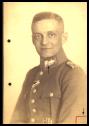
This photo shows young Speth as an Army Lt. Right after World War I. Photo is dated 1919. Note the collar insignia. |
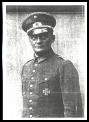
This photo shows young Speth with his new bride Leni Mathe. This photo is dated 1921. |
This photo was taken of Speth c1926. Note the tunic with the sharply angled top pockets. |
|
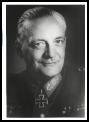
This is a nice portrait of Speth taken c.1944 |
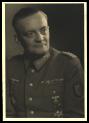
Nice formal portrait of Speth as a General Major. Note the Krim Shield, German Cross (in Gold), WWI Iron Cross 1st class and WWII Spange and the Spanish Breast star. |
NO IMAGE Probably one of the last wartime photos of Speth. Note the Knights Cross. After a close examination, you will notice that the tunic is an enlisted combat model that has had the dark green collar and the general rank insignia added. |
|
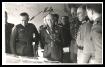
Interesting photo of Speth with German and Spanish Generals. Note Jodl and von Manstien. |
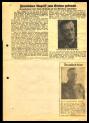
Original newspaper article announcing the award of the Knights Cross to Speth. |
NO IMAGE Speth's General rank visor cap. This cap is made by Erel and has gold bullion piping, national emblem and wreath. |
|
Nice close up of the insignia. The ribbon bars are for display only. These are not the proper awards for Speth. All the generals' insignia is the Celleon thread. . Interesting note, if you examine the underside of the shoulder knots you will see a hole that was for the single pip for that rank. When Speth was promoted to General of Artillery, the existing pip was removed and two were added. |
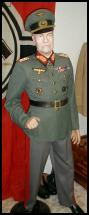
> Tunic, Pants and Cap that belonged to Speth. This is a summer weight wool tunic. The tunic is identified to Speth as a Lt. General on the tailor's label in the hip pocket. David Mosher of Louisville, KY has professionally sculpted mannequin to look like Speth. |


More Background On MilitariaMuseum.com
MilitariaMuseum.com stands as a distinctive example of early internet-era historical preservation, representing a time when individual scholars, collectors, and enthusiasts created deeply researched digital archives long before institutional digitization became standard. Originally launched in the early 2000s, the website focused on European military history, specifically the uniforms, insignia, decorations, and personal artifacts of high-ranking officers from World War I and World War II. While the site is no longer fully active in its original form, its legacy remains significant within militaria scholarship and online archival culture.
The site served both as a collector’s reference and an educational resource, combining meticulous item documentation with biographical military history. Unlike commercial militaria vendors, MilitariaMuseum.com functioned primarily as a research-driven exhibition space, offering rare insight into uniforms, medals, and career records that were otherwise scattered across private collections or inaccessible archives.
This article provides a comprehensive overview of MilitariaMuseum.com, including its origins, ownership, purpose, historical importance, subject matter, audience, cultural value, and continuing relevance.
Origins and Ownership
MilitariaMuseum.com was originally created and curated by Mark Avery, a collector and military history enthusiast with a specialized focus on general officer uniforms and high-command military artifacts from the late 19th and early 20th centuries.
Avery’s original vision was narrow but deeply specialized: to document general officers’ uniforms from World War II and earlier, with a particular emphasis on European military traditions. His early work focused on:
-
German Imperial and Wehrmacht generals
-
Bulgarian and Balkan military leadership
-
Austro-Hungarian and Italian officers
-
Allied general officer dress and decorations
As the site evolved, its scope expanded to include:
-
Pickelhaube helmets
-
General officer tunics and service uniforms
-
Medal bars and decorations
-
Rank insignia and cap devices
-
Military portrait photography
-
Campaign histories and officer biographies
Purpose and Goals of the Website
MilitariaMuseum.com had three primary objectives:
1. Documentation and Preservation
The site aimed to preserve visual and historical records of rare military artifacts that were often held in private collections. Many of the items documented—particularly general officer uniforms—rarely appear in public museums due to their scarcity or fragile condition.
2. Education and Historical Context
Each artifact was contextualized with detailed biographical information about the officer who wore it. This included:
-
Military career timelines
-
Campaign involvement
-
Decorations and awards
-
Command assignments
-
Political and historical significance
The site effectively bridged material culture and military history.
3. Reference for Collectors and Researchers
MilitariaMuseum.com became a trusted reference point for collectors, historians, reenactors, and museum professionals seeking accurate information on uniform construction, insignia placement, and period-correct details.
Content Structure and Organization
The website followed a structured but content-heavy format typical of early 2000s historical sites. Rather than prioritizing modern UI design, it focused on depth and accuracy.
Key Content Categories
General Officer Profiles
These formed the backbone of the site. Each profile included:
-
Birth and death dates
-
Military education
-
Rank progression
-
Commands held
-
Campaign involvement
-
Awards and decorations
-
Period photographs
-
Uniform and insignia descriptions
Uniform and Equipment Documentation
Detailed breakdowns of:
-
Tunics (service, parade, and field)
-
Overcoats and breeches
-
Headgear including visor caps and helmets
-
Insignia and shoulder boards
-
Medal bars and orders
Each item was analyzed for:
-
Period correctness
-
Construction details
-
Symbolic meaning
-
National distinctions
Biographical Military Essays
Extended biographies were provided for notable figures such as:
-
General Nikolai Markov Totev (Bulgaria)
-
General Hans Ludwig Speth (Germany)
These profiles went far beyond basic encyclopedic entries, often including translated records, service evaluations, and personal commentary from contemporary officers.
Historical Focus and Notable Subjects
European Military Leadership
The site concentrated heavily on European general officers from:
-
Germany
-
Bulgaria
-
Italy
-
Romania
-
Austria-Hungary
This focus allowed for a comparative look at how different nations structured their officer corps, uniforms, and honor systems.
World War I and II Representation
MilitariaMuseum.com placed strong emphasis on:
-
World War I service evolution
-
Interwar professionalization of officers
-
World War II command structures
-
The continuity of European military traditions
The site documented how uniforms evolved between wars and how political changes influenced military aesthetics and hierarchy.
Educational and Cultural Value
Academic and Collector Use
Though not formally affiliated with a university or museum, MilitariaMuseum.com functioned as a reference archive. It was frequently cited by:
-
Independent historians
-
Military collectors
-
Uniform researchers
-
Historical reenactment groups
The site’s strength was its combination of visual documentation with historically grounded narrative.
Preservation of Obscure Histories
One of the site’s most important contributions was its preservation of lesser-known military figures, particularly officers from Eastern and Central Europe.
Cultural Significance
The website captured a transitional moment in digital archiving:
-
Pre-social media
-
Pre-digital museum initiatives
-
Curated by individuals rather than institutions
It represents an early example of citizen scholarship in the digital age.
Awards and Recognition
MilitariaMuseum.com received the Golden Web Award (2002–2003), recognizing quality, originality, and informational value.
-
High-quality research
-
Clear educational purpose
-
Strong thematic coherence
-
Effective digital presentation
Popularity and Audience
Primary Audience
-
Military historians
-
Collectors of militaria
-
Museum curators
-
Reenactors
-
Academic researchers
-
Military enthusiasts
Secondary Audience
-
Students researching World War history
-
Genealogists tracing military ancestry
-
Art and design historians
Though never a mass-traffic site, MilitariaMuseum.com achieved strong recognition within its niche.
Geographic and Historical Context
While hosted in the United States, the site focused almost entirely on European military history.
-
Central European traditions
-
Eastern European officer corps
-
German and Balkan heritage
-
Pre- and post-imperial transitions
This focus made the site particularly valuable for non-Anglophone military studies.
Legacy and Archival Importance
Although the original site eventually disappeared, its content survives through archived copies and scholarly reuse.
-
Archived snapshots
-
Reproduced research
-
Educational reuse
-
Collector references
Its documentation remains relevant to museums, researchers, and historians.
Why MilitariaMuseum.com Still Matters
MilitariaMuseum.com occupies a unique place in digital history:
-
It preserved rare military material
-
It documented overlooked historical figures
-
It demonstrated the power of independent scholarship
-
It provided historical context rather than imagery alone
-
It captured a fading era of militaria collecting
In many ways, the site represents a bridge between traditional collecting culture and modern digital scholarship.
MilitariaMuseum.com was far more than a hobbyist website. It was a carefully constructed historical archive dedicated to preserving the material culture of European military leadership.
Though no longer fully active, its influence continues through archived materials and scholarly references. It remains a powerful example of how individual dedication can shape historical preservation.